
When Perspective Turns Against You… Negative Thinking and Its Effects
How Negative Thinking Warps Your Reality
We all have bad days. Days where a spilled coffee feels like a cosmic joke, a minor criticism stings like a personal attack, and every green light seems to turn red just for us. But what if those bad days start to blur into weeks, months, or even years? What if the way you see the world isn't just a temporary gloom, but a pervasive, self-reinforcing pattern of negativity that actively warps your reality?
Negative thinking isn't merely feeling sad or disappointed; it's a profound shift in perspective that can fundamentally alter how you perceive yourself, others, and the world around you. This isn't just a philosophical musing; it's a well-documented phenomenon with significant psychological and physiological consequences. This post will delve into the hidden patterns of distorted thinking that fuel anxiety, self-doubt, and hopelessness, exploring how these "negative lenses" limit growth and satisfaction, and crucially, what we can do to challenge them.
The Architects of Our Misery: Common Cognitive Distortions
The pioneering work of Dr. Aaron Beck and later Dr. David Burns brought to light the concept of "cognitive distortions", systematic errors in thinking that lead to biased views of reality. These aren't intentional lies we tell ourselves, but rather ingrained mental habits that develop over time. Understanding them is the first step toward dismantling them.
Some of the most common that have been identified are:
All-or-Nothing Thinking (Black-and-White Thinking): This distortion involves seeing things in extreme categories, with no middle ground. If your performance isn't perfect, it's a total failure. If someone isn't entirely on your side, they're against you.
Example: "I got a B on that exam, so I'm completely useless and will never succeed in anything."
Impact: This distortion prevents us from acknowledging progress, learning from mistakes, and appreciating the nuances of life. It creates immense pressure and anxiety.
Overgeneralization: Taking a single negative event and seeing it as a never-ending pattern of defeat. A single rejection becomes proof that you'll "always be alone."
Example: After a bad job interview: "I'll never get a good job. I always mess things up."
Impact: Overgeneralization fosters a sense of helplessness and can lead to avoidance behaviors, preventing us from trying new things or re-engaging with past challenges.
Mental Filter: Dwelling on a single negative detail while ignoring all the positive aspects of a situation. It's like a single drop of ink tainting a whole glass of clear water.
Example: You receive a performance review with glowing praise and one minor suggestion for improvement. You fixate solely on the suggestion, feeling inadequate.
Impact: This distortion robs us of joy and gratitude, making it impossible to appreciate successes and positives, leading to chronic dissatisfaction.
Discounting the Positive: Insisting that positive experiences, acts, or qualities "don't count." If someone compliments you, you might dismiss it by thinking, "They're just being nice" or "It was a fluke."
Example: "Sure, I got that promotion, but it was just because no one else applied."
Impact: This is particularly insidious as it actively undermines self-esteem and makes it difficult to internalize genuine achievements, leaving us feeling undeserving and unworthy.
Jumping to Conclusions: Making negative interpretations even when there are no definite facts to support them. This often takes two forms:
Mind Reading: Assuming you know what others are thinking negatively about you without any direct evidence.
Example (Mind Reading): Your friend didn't text back immediately, so you assume they're angry with you.
Fortune Telling: Arbitrarily predicting that things will turn out badly.
Example (Fortune Telling): "There's no point in applying for that scholarship; I know I won't get it."
Impact: Leads to unnecessary anxiety, strained relationships, and self-sabotaging behaviors, as we often act on these unverified assumptions.
Magnification (Catastrophizing) and Minimization: Exaggerating the importance of negative events (catastrophizing) and downplaying the significance of positive ones.
Example (Catastrophizing): Making a small mistake at work leads to thoughts of being fired and losing everything.
Example (Minimization): Dismissing your excellent presentation as "just getting lucky."
Impact: Fuels intense anxiety, paralyzing fear, and a sense of being overwhelmed, while simultaneously eroding self-confidence.
Emotional Reasoning: Assuming that your negative emotions necessarily reflect reality. "I feel like a failure, therefore I am a failure."
Example: "I feel anxious about giving this presentation, so it must mean I'm going to do terribly."
Impact: Blurs the lines between feelings and facts, preventing us from objectively assessing situations and often leading to self-fulfilling prophecies.
"Should" Statements: Trying to motivate yourself with "shoulds" and "musts," often leading to guilt, shame, and resentment when you don't meet these rigid expectations.
Example: "I should always be productive." "I must never make mistakes."
Impact: Creates unnecessary pressure, guilt, and can lead to rebellion against these self-imposed rules, resulting in procrastination or a sense of inadequacy.

The Vicious Cycle: Thought, Emotion, and Behavior
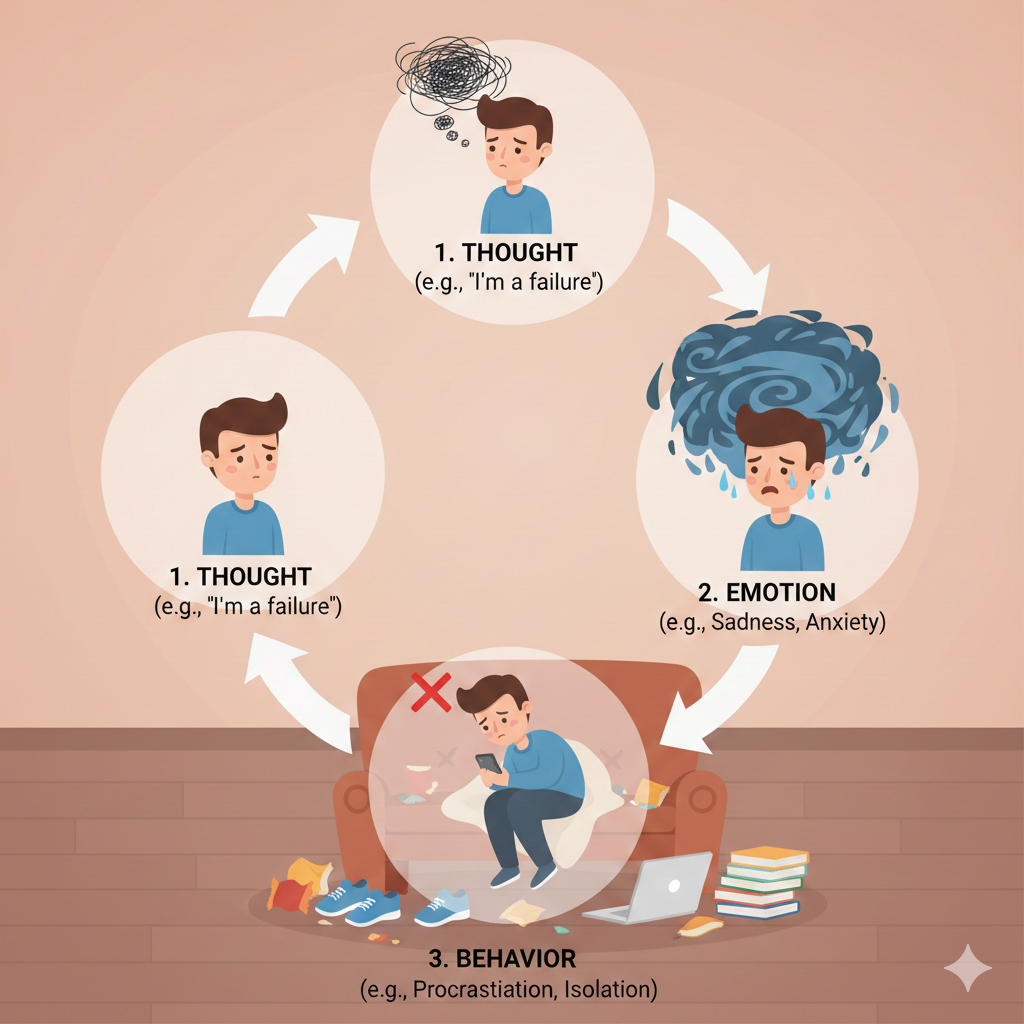
Cognitive distortions don't operate in a vacuum; they are integral parts of a powerful feedback loop that connects our thoughts, emotions, and behaviors. This cycle can be a virtuous one, propelling us towards growth and well-being, or a vicious one, trapping us in negativity.
Thought: It begins with a negative thought, often a cognitive distortion. For instance, "I'm a complete failure."
Emotion: This thought triggers a corresponding negative emotion, such as sadness, anxiety, hopelessness, or shame. Feeling like a failure naturally leads to feelings of inadequacy and despair.
Behavior: These emotions then influence our behavior. If we feel like a failure, we might withdraw, procrastinate, avoid challenges, or give up entirely.
Reinforcement: This behavior, in turn, reinforces the initial negative thought. By avoiding a task and then failing to achieve a goal, the thought "See? I told you I was a failure" is strengthened.
This cycle, described in numerous peer-reviewed articles on Cognitive Behavioral Therapy (CBT), demonstrates how a single distorted thought can spiral into a self-perpetuating pattern. Research by Hofmann et al. (2012) in Cognitive Therapy and Research highlights the empirical support for CBT's effectiveness in addressing this cycle across various anxiety and mood disorders. By targeting and changing maladaptive thoughts and behaviors, CBT aims to break this negative feedback loop.
The Limiting Lenses: How Negative Thinking Stifles Growth and Satisfaction
When we consistently view the world through these negative lenses, it's not just our mood that suffers. Our capacity for growth, achievement, and genuine satisfaction is severely diminished.
1. Reduced Motivation and Procrastination: If every effort is seen as futile, or every outcome as destined for failure, why bother trying? This mindset breeds procrastination and a lack of motivation, trapping individuals in inaction. Research by Mann et al. (2017) in Motivation and Emotion explores the intricate relationship between negative affect, cognitive distortions, and procrastination, suggesting that these thinking patterns directly contribute to avoidance behaviors.
2. Impaired Problem-Solving: Negative thinking narrows our perspective, making it harder to see solutions or alternative approaches. When focused on the catastrophic potential of a problem, our creative and analytical abilities are stifled. A study by Eysenck et al. (2007) on worry and problem-solving, though slightly older, laid foundational work demonstrating how negative rumination consumes cognitive resources, hindering effective problem-solving strategies. More recent work, such as that by Watkins & Roberts (2020) in Clinical Psychology Review, continues to emphasize how maladaptive rumination, a form of negative thinking, impacts executive functions and problem-solving.
3. Damaged Relationships: Cognitive distortions like mind-reading and overgeneralization can lead to misunderstandings, mistrust, and conflict in personal relationships. Assuming the worst of others or taking minor slights personally erodes intimacy and connection.
4. Increased Risk of Mental Health Issues: Prolonged exposure to negative thinking patterns is a significant risk factor for developing or exacerbating mental health conditions like depression and anxiety disorders. The constant stress and emotional strain take a toll on our psychological well-being. Disner et al. (2011), in a review published in Psychological Bulletin, detailed how cognitive models of depression consistently identify negative cognitive biases as core mechanisms in the onset and maintenance of depressive episodes.
5. Physical Health Impacts: The mind-body connection is undeniable. Chronic negative thinking and the associated stress response can manifest physically, impacting sleep, immune function, and cardiovascular health. While not a direct cognitive distortion study, the extensive body of work on stress physiology, such as that summarized by Cohen et al. (2012) in Annual Review of Psychology, demonstrates how psychological stress, often fueled by negative appraisals, leads to detrimental physiological changes.
Breaking Free: Challenging the Negative Lenses
The cycle of negativity can feel like an inescapable prison, but the very fact that it is a learned pattern means it can be unlearned. Cognitive restructuring is the process of identifying, challenging, and replacing these distorted thoughts with more balanced, realistic ones.
Here is how you can begin to shift your perspective:
1. Identify the Distortion
The first step is awareness. You cannot change a thought you don’t notice. When you feel a sudden drop in your mood—a surge of anxiety or a wave of hopelessness—stop and ask yourself: "What was I just thinking?" Once you catch the thought, label it. Is it Catastrophizing? Is it All-or-Nothing thinking? Labeling the thought creates a "cognitive distance," allowing you to see the thought as a mental event rather than an objective fact.
2. Examine the Evidence
Treat your negative thought like a witness in a courtroom. Instead of accepting it at face value, ask for the facts.
What evidence is there that this thought is true?
What evidence is there that it is not true?
Am I ignoring any facts or oversimplifying the situation?
Research by Dozois et al. (2014) in the Journal of Abnormal Psychology indicates that individuals who actively engage in "cognitive re-appraisal"—the act of reinterpreting a situation to change its emotional impact—show significantly higher levels of resilience and lower symptoms of depression.
3. The "Double-Standard" Technique
We are often our own harshest critics. If a friend came to you with the same negative thought, would you say to them, "Yes, you're a total failure and you'll never succeed"? Likely not. You would offer them compassion and a more balanced perspective. Apply that same kindness to yourself.
4. Practice Mindfulness and Acceptance
While CBT focuses on changing thoughts, "Third Wave" therapies like Acceptance and Commitment Therapy (ACT) suggest a different approach: noticing thoughts without judgment. Instead of fighting the thought "I'm not good enough," you might say, "I am having the thought that I'm not good enough."
A peer-reviewed meta-analysis by Khoury et al. (2013) in Clinical Psychology Review found that mindfulness-based interventions are highly effective at reducing the "stickiness" of negative thoughts, preventing them from spiraling into the feedback loop of despair.
Reclaiming Your Reality
Negative thinking is a powerful force, but it isn’t a permanent state of being. By understanding the common cognitive distortions that warp our reality and recognizing the feedback loop between our thoughts, emotions, and behaviors, we can begin to dismantle the mental barriers that hold us back.
Growth isn't about forced positivity or ignoring the hardships of life; it’s about achieving a balanced perspective that allows for both the acknowledgement of challenges and the recognition of your own agency and potential.
References and Further Reading
Cohen, S., Janicki-Deverts, D., & Miller, G. E. (2012). Psychological stress and disease. Annual Review of Psychology, 63, 407-433.
Disner, S. G., Beevers, C. G., Haigh, E. A., & Beck, A. T. (2011). Neural mechanisms of the cognitive model of depression. Nature Reviews Neuroscience, 12(8), 467-477.
Dozois, D. J., et al. (2014). Cognitive vulnerability to depression: A dual-process model. Journal of Abnormal Psychology, 123(1), 1–13.
Hofmann, S. G., Asnaani, A., Vonk, I. J., Sawyer, A. T., & Fang, A. (2012). The efficacy of cognitive behavioral therapy: A review of meta-analyses. Cognitive Therapy and Research, 36(5), 427-440.
Khoury, B., et al. (2013). Mindfulness-based therapy: A comprehensive meta-analysis. Clinical Psychology Review, 33(6), 763-771.
Mann, L., et al. (2017). Procrastination and negative affect: The role of cognitive distortions. Motivation and Emotion, 41(4), 513–525.
Watkins, E. R., & Roberts, H. (2020). Reflecting on rumination: Consequences, causes, and mechanisms of habit. Clinical Psychology Review, 75, 101801.